
The debt avalanche method has one clear selling point: mathematically, it's the cheapest way to pay off multiple debts. List every debt, pay the minimum on all of them, and send every extra dollar to whichever one has the highest interest rate. When that one's gone, roll its payment into the next-highest rate. Repeat until nothing's left.
That pitch is easy to say yes to. What's harder to picture, until the tracker is actually built, is what the payoff order looks like in practice, and how long it can take before any single debt actually disappears.
Here's how to build one by hand, what the order does to your first win, and where that tradeoff matters more than the spreadsheet will tell you.
Set up the debt list, sorted by rate instead of balance
Same four columns as any payoff tracker: name, balance, minimum payment, interest rate. The rate is the one that actually decides the order here, so get it right for every debt before sorting anything.
A household with three debts:
| Debt | Balance | Minimum | Rate |
|---|---|---|---|
| Store card | $900 | $30 | 15.99% |
| Credit card | $3,100 | $75 | 26.99% |
| Personal loan | $5,400 | $120 | 10.49% |
Sort by rate, highest first, and the credit card goes to the top, even though it's not the smallest balance and not the largest. Sorted by balance instead, the store card would be the obvious first target at just $900. Sorted by rate, it drops to second. If this household has $175 a month to put toward extra payments, the credit card gets its $75 minimum plus that $175, $250 a month, while the store card and the personal loan sit at just their minimums for now.
Track it the same way, watch the timeline change
The month-by-month mechanics are ordinary: every debt's new balance is last month's, minus what was paid, adjusted for interest. The target gets the minimum plus the full extra amount. Everything else gets just its minimum. And there's a maintenance problem built in: the day the credit card clears, its $250 has to get re-pointed to whichever debt is next by rate, and every formula downstream of that needs to change.
What's easy to miss until the tracker is running is how long that first payoff actually takes. Point the same $175 a month at the store card instead, the smaller balance, and it clears in around month 5. Point it at the credit card, because the rate says to, and that first payoff doesn't land until somewhere around month 14. Same household, same extra $175 a month, close to three times as long before a single balance actually hits zero.
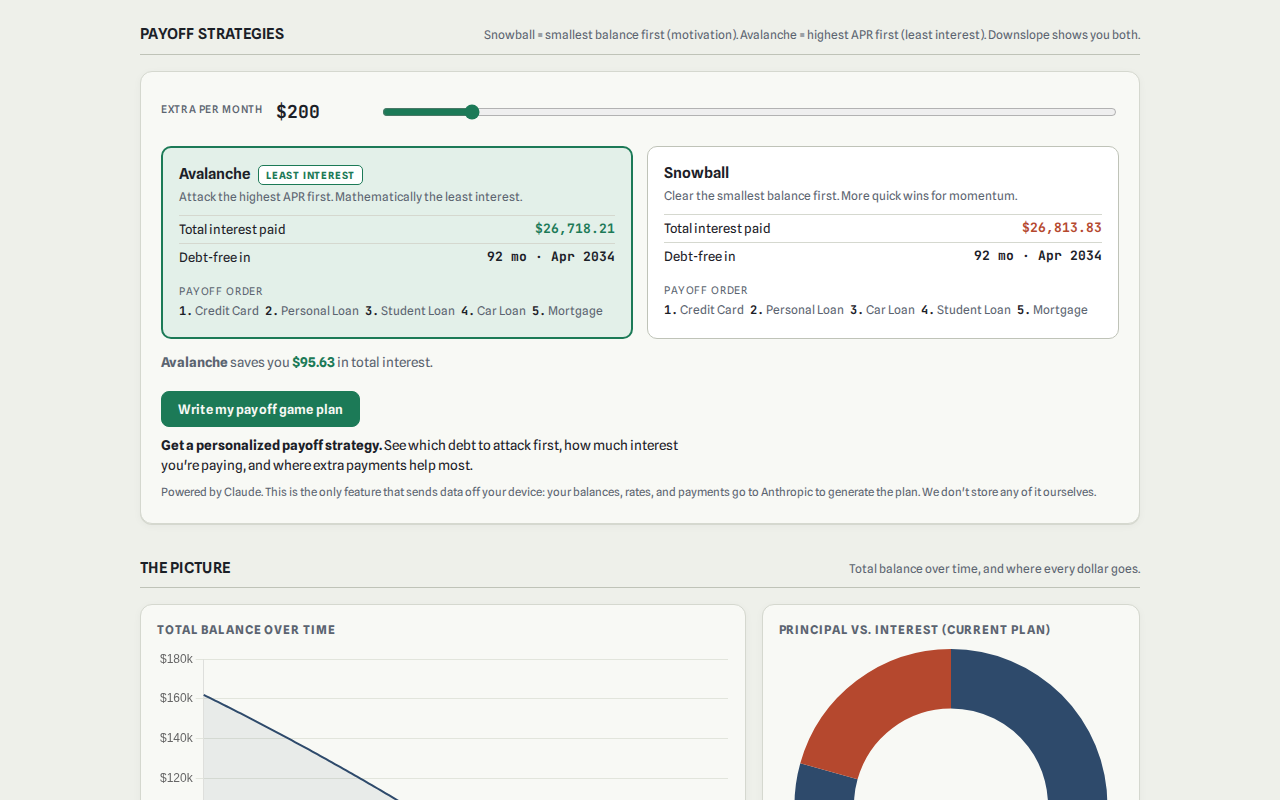
Shown with sample data for illustration.
The real tradeoff isn't in the math
Over the life of all three debts, avalanche will save more in total interest than sorting by balance would. That's the whole reason it exists, and a calculator can show the exact number for your own debts. What a spreadsheet won't tell you is whether you'll still be sending that extra $175 in month thirteen if nothing on the list has disappeared yet.
That's not a knock on the math. It's a real question about which kind of progress actually keeps someone paying extra every month: watching a balance shrink toward zero, or watching a projected total get smaller. Some people don't need the early win, the total savings is motivating enough on its own. Others find that six months of a debt list that looks unchanged is exactly when the extra payments quietly stop.
A way to decide without building two trackers
The honest answer is that either order works if you keep paying extra every month, and neither one works if you don't. Before committing to a tracker by hand, it's worth running both orders against your actual debts, even roughly, and comparing two numbers: how much total interest each one saves, and how many months until each one's first debt actually clears.
If those two numbers are close, the decision mostly comes down to which kind of motivation you trust yourself to sustain. If they're far apart, that gap is worth knowing before you're six months into a tracker that assumed you'd be fine waiting.
If sorting by rate saves you more money but the first debt on the list won't clear for over a year, is that still the right order for you, or is a faster first win worth paying a little more interest for?